Posts

Showing posts with the label bjj denmark

About the fundamental offensive positions in brazilian jiu jitsu

About the fundamental offensive positions in brazilian jiu jitsu As we have been learning, brazilian jiu jitsu is a game of positions and transitions between them, looking to get dominant positions, not allowing the opponent to escape as you find gaps, or generate openings for executing submissions: The most dominant positions from which you can launch submissions, sweeps or go to other dominant positions are the following: Guard (Closed, Half Guard or Open variants such as Sitting, Spider, X, de la Riva, Butterfly among others): from the guard you can sweep, take the back or submit Side Control  or 100 kilos: you can transition to the back or mount or submit Knee in the Belly: you can transition to the back or mount or submit Mount: you can transition to the back or submit Back: you can transition to the mount or submit Turtle or four points: you can take the back or submit  
About Sport BJJ competition.

Image
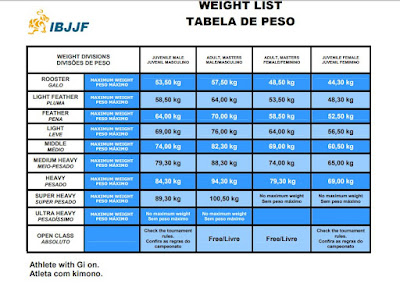
 About Sport BJJ competition. In official Brazilian jiu jitsu competitions, the fights begin standing up and have a specific duration for each belt in the adult category (athletes between 16 and 30 years old), the duration being as follows: White belts: 5 minutes Blue belts: 6 minutes Purple belts: 7 minutes Brown belts: 8 minutes Black belts: 10 minutes From 30 years and on there are the Masters categories and in these categories all the fights are 5 minutes long. The athletes are grouped into categories by (belt, weight and age) I leave an image of the IBJJF weight categories:     How is the winner decided? In a fight the winner is decided by submission or by points. Whoever makes the opponent surrender via submission wins, and the fight ends at that moment regardless of whether the loser had more points than the winner. If at the end of the fighting time neither of the two athletes has submitted their opponent, the one that has scored more points or advantages wins. To...

About the differences between Brazilian jiu Jitsu for sports and for self-defense.

About the differences between Brazilian jiu Jitsu for sports and for self-defense. The fundamental difference is that in Brazilian jiu jitsu applied to self-defense, the aim is to play on top and never pull guard. We seek to close the distance while defending punches and kicks, perform a clinch and takedown that allows us to fall on the attacker and establish dominant positions (side control, mount or back) The fundamental objective is control and submission with the least possible damage. That's why strangulations such as the Mata Leon and The Arm Triangle are especially effective.  

About the the belts in Brazilian Jiu Jitsu

Image
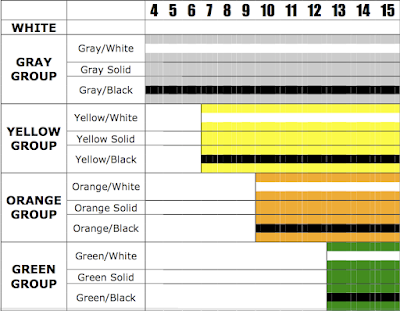
About the the belts in Brazilian Jiu Jitsu In Brazilian jiu jitsu there are only seven belts for those of legal age (16 years old). The times to win each belt depend on the hours of training and achievement of some requirements for most teams and academies. However, after reaching the black belt the degrees follow fixed periods of time, first every three years and then every five years. These are the brazilian jiu jitsu belts: White Blue Purple Brown Black Coral Red For those under 16 years of age there is another group of belts which are those seen in the following image:  

About the History of Science of Jiu Jitsu Team

About the History of Science of Jiu Jitsu Team The beginnings In 2013, Mario Rodríguez (three-degree brown belt from Yan Cabral at the moment) began teaching in Terrassa, Barcelona taking in charge a group that had been led by Jose Pelegrin a Robin Gracie black belt . In June 2017 the team became part of Oscar Corrales Academy and Mario Rodriguez received his black belt from Oscar Corrales and Andre Crispin and launched his team project Science of Jiu Jitsu Team. Why the name of the Team? The team owes its name to our commitment to the search for the factors and details that guarantee maximum efficiency in each of the jiu jitsu techniques and movements and the constant work of learning from the greatest exponents and masters of the discipline. Also with the intention of establishing teaching programs that help the best and fastest evolution of students. Science of Jiu JitsuIts broader mission is the dissemination of BJJ to people of all ages and physical conditions and its application ...

About the differences between Brazilian Jiu Jitsu, contact martial arts, and other grappling modalities.

Differences with contact martial arts and sports. The fundamental differences are the prohibition of punches and kicks in the sport context, with the application of joint locks and chokes as main methods of finishing the fight. In the non-sport context the difference is that although punches and kicks can be applied, they are not the fundamental objective of Brazilian jiu jitsu. In case of applying them, the idea is to distract or generate openings in the opponent to gain control or finishing positions without causing injuries. In this sense, two of the safest and least damaging submissions are the Mata leon and Kata gatame. Differences with respect to other martial arts that do not use punches, such as Judo or Olympic wrestling (in Free and Greco-Roman variants). The fundamental difference is that in this type of sports, the main goal is getting a takedown and keep the opponent pinned, while In Brazilian jiu jitsu a takedown and a pin doesn't secures the win, and you can even get ...

About the Purple Belt in Brazilian Jiu Jitsu

Image
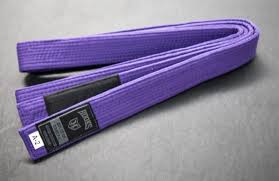
The purple belt is one of the most rewarding belts in Brazilian jiu jitsu but at the same time one of the most frustrating for many people when they don't see the brown belt coming. In our opinion, the fundamental problem with the purple belt is that it requires the development of a personal game, where each person begins to choose and perform certain techniques and combine them to make them more efficient. Whereas a blue belt knows the basics and has an arsenal of  techniques so to speak, the purple belt begins to specialize in some guard passes, takedowns, sweeps  and submissions. It is at this point where it is necessary to understand that the development of this game of combinations is something very personal and that it takes a different time for each person. Many purple belts ask teachers what they need to do to get to brown or believe that evolution depends on learning more techniques instead of polishing their techniques and combinations to make them more efficient. So...

Jiu Jitsu: The importance of free training.

Brazilian Jiu Jitsu: The relevance of free training. Free training is usually one of the training sessions that receives the least attention when learning jiu jitsu, however they can play a very large role in your evolution. In this article we share some recommendations so that you can get the most out of this type of training and help you progress faster. Let´s take a look at them. Don't just sparr. First of all, it is very important that you do not take advantage of them only to do more fighting. Spend some of this free time organizing other types of training that will also help you improve. Here we review some of them: Work on technical solutions to your problems. In this sense, it is important that you come to the gym with a goal and prepare what you want to train. That you select the techniques that you need to learn to incorporate new resources into your game and others that help you improve the problems you are having. Divide the time to work equally on both sets of techniqu...