Posts

Showing posts with the label brazilian jiu jitsu classes at kalundborg

About the ways to surrender in a Brazilian jiu jitsu fight

 About the ways to surrender in a Brazilian jiu jitsu fight Although it may seem obvious to those who have been in Brazilian jiu jitsu for some time, for those who are starting out it is not so easy to find a way to express that we give up due to a submission, danger of injury or simply due to fatigue or overwhelm. For this reason, it is important to know how to express that you give up in a Brazilian jiu jitsu fight. Possibly the most used way is to hit lightly, with the palm of the hand on some part of the opponent's torso or on his arms. The second way can be to kick against the ground in case both of our arms are blocked. And the third and surely the most efficient is to express it verbally saying "Tap". As we said initially, it is very important to recognize that many times we must indicate that we want to stop the fight not only because we are caught in a submission but also to communicate that a finger has been trapped, that we are going to fall badly or that we ar...
About the fundamental movements in brazilian jiu jitsu

About the fundamental movements in brazilian jiu jitsu There are a lot of movements that are very important in brazilian jiu jitsu and that may be considered foundations for techniques and transitions. So we work regularly on these movements  doing drills, these are the ones we consider more relevant: Backward fall break: http://bluebeltuniversity.blogspot.com.es/2017/12/caida-hacia-atras.html Side Fall break: https://www.youtube.com/watch?v=wFL3vYVXvHY Front fall break: http://bluebeltuniversity.blogspot.com.es/2017/12/caida-hacia-adelante.html https://www.youtube.com/watch?v=2CLBeDR6kcM Video with the three :  https://www.youtube.com/watch?v=5n_Qjeia2n8 https://www.youtube.com/watch?v=mwmy9NU_DEw&feature=emb_rel_end Shrimp:   http://bluebeltuniversity.blogspot.com.es/2017/12/la-gamba-en-brazilian-jiu-jitsu.html Reverse Shrimp: http://bluebeltuniversity.blogspot.com.es/2017/12/gamba-invetida.html Shrimp and going to fours: http://bluebeltuniversity.blogspot.com.es/20...

About the positional hierarchy and the positional transitions in the brazilian jiu jitsu game

Image
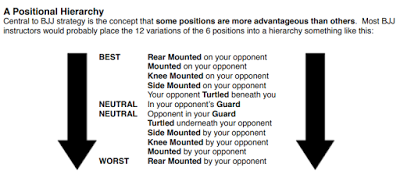
About the positional hierarchy and the positional transitions in the brazilian jiu jitsu game As we said before Brazilian jiu jitsu is fundamentally a game of transition of positions Below I leave two images that illustrate some of the most frequent position changes in a Brazilian jiu jitsu fight.   As seen in this image, the continuum of positions goes from being in the best, behind the opponent's back, to the worst when it is he who is behind our back. This other graphics describes some of the most common positional changes that usually occur during the sparring Fundamental transitions in Brazilian jiu jitsu:  

About the fundamental offensive positions in brazilian jiu jitsu

About the fundamental offensive positions in brazilian jiu jitsu As we have been learning, brazilian jiu jitsu is a game of positions and transitions between them, looking to get dominant positions, not allowing the opponent to escape as you find gaps, or generate openings for executing submissions: The most dominant positions from which you can launch submissions, sweeps or go to other dominant positions are the following: Guard (Closed, Half Guard or Open variants such as Sitting, Spider, X, de la Riva, Butterfly among others): from the guard you can sweep, take the back or submit Side Control  or 100 kilos: you can transition to the back or mount or submit Knee in the Belly: you can transition to the back or mount or submit Mount: you can transition to the back or submit Back: you can transition to the mount or submit Turtle or four points: you can take the back or submit  

About the 4 main scenarios and goals for each of them in brazilian jiu jitsu

  About the 4 main scenarios and goals for each of them in brazilian jiu jitsu There are a lot of situations and scenarios happening during sparring but you need to identify the most common and relevant for understanding the “game” and organize the techniques you're learning in the context of each of them. Some of the more frequent are the following: Taking down the opponent and go for dominant positions and submission Passing the opponents guard if he plays guard. Going for dominant positions and looking for submissions Play Guard for: Sweep, come on top and go for dominant positions and submissions Take the opponents back Go for direct submissions       4. Defend and escape from bad positions and go to good ones

About the fundamental positions in Brazilian Jiu Jitsu

About the fundamental positions in Brazilian Jiu Jitsu Brazilian jiu jitsu is fundamentally a game of transition of positions. We are seeking positions of maximum control like the back, from where we can exert maximum control over the opponent. But in reality it is a dynamic game where at one moment you can be in a dominant situation and suddenly go into defense in a disadvantageous position. The most relevant positions are: Guard (Closed, Half Guard or Open (variants such as Sitting, Spider, X, de la Riva, Butterfly among others) Side Control  or 100 kilos Knee in the Belly Mount Back Turtle or four points  

About the differences between brazilian jiu jitsu with the gi and no gi

About the differences between brazilian jiu jitsu with the gi and no gi The main differences between practicing brazilian jiu jitsu with the gi and without it are that you can not grab the clothes while you are training in no gi. Instead of making grips on any cloth of your partner you should use wrist grabs and neck ties, in the legs you can grip the partner's ankles. With regards to rules and the rest of sport aspects everything is the same except that some submissions are allowed for black belts in the adult category (up to 30 years) in competitions (heel hooks for instance)  

About Sport BJJ competition.

Image
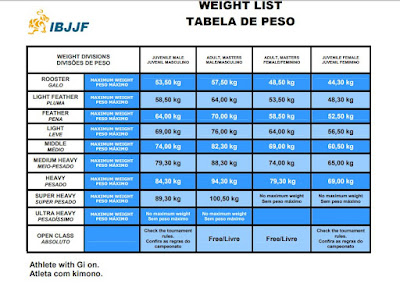
 About Sport BJJ competition. In official Brazilian jiu jitsu competitions, the fights begin standing up and have a specific duration for each belt in the adult category (athletes between 16 and 30 years old), the duration being as follows: White belts: 5 minutes Blue belts: 6 minutes Purple belts: 7 minutes Brown belts: 8 minutes Black belts: 10 minutes From 30 years and on there are the Masters categories and in these categories all the fights are 5 minutes long. The athletes are grouped into categories by (belt, weight and age) I leave an image of the IBJJF weight categories:     How is the winner decided? In a fight the winner is decided by submission or by points. Whoever makes the opponent surrender via submission wins, and the fight ends at that moment regardless of whether the loser had more points than the winner. If at the end of the fighting time neither of the two athletes has submitted their opponent, the one that has scored more points or advantages wins. To...

About the differences between Brazilian jiu Jitsu for sports and for self-defense.

About the differences between Brazilian jiu Jitsu for sports and for self-defense. The fundamental difference is that in Brazilian jiu jitsu applied to self-defense, the aim is to play on top and never pull guard. We seek to close the distance while defending punches and kicks, perform a clinch and takedown that allows us to fall on the attacker and establish dominant positions (side control, mount or back) The fundamental objective is control and submission with the least possible damage. That's why strangulations such as the Mata Leon and The Arm Triangle are especially effective.  

About how the fights begin in Brazilian Jiu Jitsu

About how the fights begin in Brazilian Jiu Jitsu The fights in brazilian jiu jitsu (in sparring and in competition) begin standing, although in some gyms and circumstances people decide to pull guard quickly or go to seated guard while training. You should know that in competition you are not allowed to pull guard without any grip. That is why we highly recommend starting every fight standing even at gym sparring. This will help you get accustomed to always begin standing, defending the takedowns, guard pulls or working yourself in these areas.  

About the the belts in Brazilian Jiu Jitsu

Image
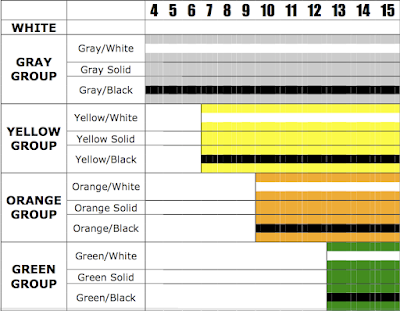
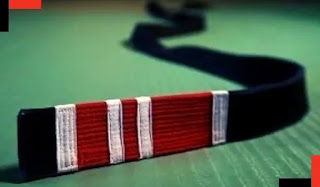
About the the belts in Brazilian Jiu Jitsu In Brazilian jiu jitsu there are only seven belts for those of legal age (16 years old). The times to win each belt depend on the hours of training and achievement of some requirements for most teams and academies. However, after reaching the black belt the degrees follow fixed periods of time, first every three years and then every five years. These are the brazilian jiu jitsu belts: White Blue Purple Brown Black Coral Red For those under 16 years of age there is another group of belts which are those seen in the following image:  

About the History of Science of Jiu Jitsu Team

About the History of Science of Jiu Jitsu Team The beginnings In 2013, Mario Rodríguez (three-degree brown belt from Yan Cabral at the moment) began teaching in Terrassa, Barcelona taking in charge a group that had been led by Jose Pelegrin a Robin Gracie black belt . In June 2017 the team became part of Oscar Corrales Academy and Mario Rodriguez received his black belt from Oscar Corrales and Andre Crispin and launched his team project Science of Jiu Jitsu Team. Why the name of the Team? The team owes its name to our commitment to the search for the factors and details that guarantee maximum efficiency in each of the jiu jitsu techniques and movements and the constant work of learning from the greatest exponents and masters of the discipline. Also with the intention of establishing teaching programs that help the best and fastest evolution of students. Science of Jiu JitsuIts broader mission is the dissemination of BJJ to people of all ages and physical conditions and its application ...

About the differences between Brazilian Jiu Jitsu, contact martial arts, and other grappling modalities.

Differences with contact martial arts and sports. The fundamental differences are the prohibition of punches and kicks in the sport context, with the application of joint locks and chokes as main methods of finishing the fight. In the non-sport context the difference is that although punches and kicks can be applied, they are not the fundamental objective of Brazilian jiu jitsu. In case of applying them, the idea is to distract or generate openings in the opponent to gain control or finishing positions without causing injuries. In this sense, two of the safest and least damaging submissions are the Mata leon and Kata gatame. Differences with respect to other martial arts that do not use punches, such as Judo or Olympic wrestling (in Free and Greco-Roman variants). The fundamental difference is that in this type of sports, the main goal is getting a takedown and keep the opponent pinned, while In Brazilian jiu jitsu a takedown and a pin doesn't secures the win, and you can even get ...

About the black belt requirements in Brazilian Jiu Jitsu

Image
The black belt is the goal of many of the people who start the Brazilian Jiu Jitsu journey but unfortunately it is said that only one in 1000 achieve it. Many factors are involved in this process, ranging from motivational factors to life changes that occur during the 10 years it takes normally to earn a black belt. In this article we want to offer our points of view on some of the most important conditions to complete the path and on the requirements to access this precious moment. About the conditions: Staying in training for ten years on a regular basis, overcoming injuries, illnesses, family and work events is something really difficult and requires a very important passion and determination. That is why in many cases any of these factors end up causing the abandonment of jiu jitsu. From our point of view it takes a great passion for learning and for jiu jitsu itself to overcome the obstacles and difficulties that arise during that time. Most of the people who start the practice of...

Jiu Jitsu and how to progress faster

Image
Brazilian Jiu Jitsu and types of training to progress faster: When we start learning Brazilian jiu jitsu we feel a big gap between what we have been taught in class and the possibility of using those techniques during sparring. It is true that starting with some kind of Fundamentals Program helps to minimize this feeling and frustration but it does not reduce it completely. This is due to the large number of areas that make up the Brazilian jiu jitsu game and the difficulty of being able to quickly learn all the techniques and resources necessary to fight efficiently. The reality is that in the first few months we spent a lot of time in disadvantageous positions, trying to escape from them and defending the opponent's attacks. One thing that will help you get through this phase of initial frustration and lag is to understand that there are different types of training  and that each will help you in a different way.   Understanding that they are all useful and that it is best ...

Brazilian Jiu Jitsu classes at Kalundborg

Image
Brazilian jiu jitsu at Kalundborg: Join a new journey. If you are looking for a fun and challenging sport, martial art and self defense system we encourage you to try a free brazilian jiu jitsu class at Kalundborg. Brazilian  Jiu Jitsu is grappling modality with no kicks and punches allowed, and it is practiced by thousands of people of all ages around the world. Classes take place Tuesdays and Thursdays from 19:30 to 21:30 in  Bevægelseshuset Spiralen , Herredsåsen 7, 4400 Kalundborg Why training brazilian jiu jitsu in Kalundborg. Brazilian Jiu Jitsu is a sport, martial art and personal defense system with thousands of practitioners around the world. People from all ages are practicing brazilian jiu jitsu and living the bebefits of this grappling art with no punches nor kicks allowed in its sportive modality. It is a very phisical activity but people from all conditions can learn it adjusting and improving his physical state. We have classes for all levels with follow up pro...